
When people think about the internet, they often imagine something invisible: cloud platforms, wireless signals, satellites, and endless streams of data moving through the air.
In reality, the modern internet is surprisingly physical.
Every video call, cloud application, online payment, streamed movie, AI request, and business transaction depends on a vast network of infrastructure spread across the world. One of the most important parts of that infrastructure lies thousands of meters beneath the ocean’s surface.
The global internet runs on submarine cables.
The Hidden Backbone of the Internet
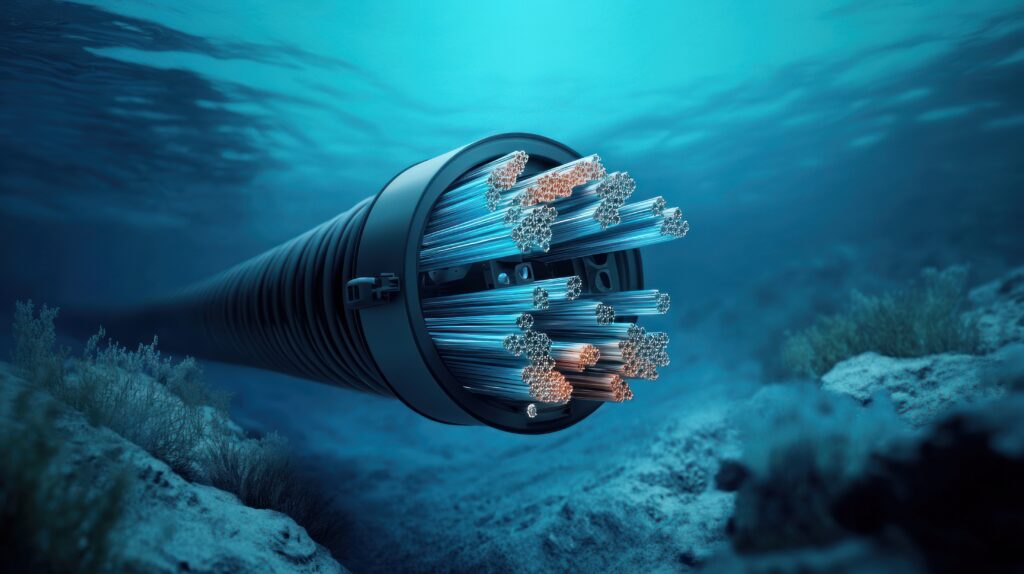
Submarine cables are fiber-optic cables laid across the seabed, connecting continents and carrying enormous volumes of data between countries and regions.
Today, more than 95% of intercontinental internet traffic travels through undersea cable networks rather than satellites. These cables form the backbone of global communications because they can carry significantly more data at a much lower cost. (TeleGeography Resources)
Despite the popular perception that satellites power global connectivity, they account for only a small fraction of international communications capacity. Fiber-optic cables remain faster, cheaper, and far more efficient for moving data across the world. (www2.telegeography.com)
A Global Network Beneath the Sea
The scale of this infrastructure is enormous.
According to TeleGeography’s global submarine cable tracking data, there are now nearly 600 active or under-construction submarine cable systems worldwide, connecting more than 1,700 landing stations across different countries and regions. (submarine-cable-map-2025.telegeography.com)
Together, these cables stretch across oceans, linking North America, Europe, Asia, Africa, South America, and Oceania into a single interconnected network.
A message sent from London to New York, a cloud request processed in Frankfurt, or a video streamed from Singapore often travels through multiple cable systems before reaching its destination.
How Data Travels Underwater
Modern submarine cables use fiber-optic technology.
Inside each cable are thin strands of glass through which information travels as pulses of light. These signals move at extraordinary speeds across thousands of kilometers of ocean floor. Protective layers of plastic, insulation, and steel shielding help the cables withstand harsh underwater environments. (data.marine.copernicus.eu)
While they may appear delicate, these systems are engineering achievements designed to operate continuously for decades while carrying vast amounts of global traffic.
The Companies Building the Modern Internet
Historically, telecommunications companies built and operated most submarine cable networks.
Today, major technology companies are increasingly investing directly in global connectivity infrastructure. Companies such as Google, Meta, Microsoft, and Amazon have become major participants in cable development as demand for cloud computing, streaming services, AI workloads, and digital platforms continues to grow. (TechRadar)
As global data consumption increases, these companies are investing in larger and faster cable systems capable of supporting future digital demand.
Why This Infrastructure Matters
Submarine cables are responsible for far more than internet browsing.
They support cloud platforms, financial transactions, enterprise systems, government communications, streaming services, remote work, AI infrastructure, and global business operations.
In many ways, they are among the most important pieces of infrastructure in the modern economy.
Recent disruptions have demonstrated how critical these networks are. In 2025, damage to several major cable systems in the Red Sea affected connectivity between Europe, Asia, and the Middle East, disrupting approximately 17% of global internet traffic and causing noticeable performance impacts across multiple regions. (Windows Central)
A Growing Strategic Priority
As the world becomes more dependent on digital services, submarine cables are increasingly viewed as strategic infrastructure.
Governments, technology companies, and international organizations are investing in network resilience, new cable routes, monitoring systems, and repair capabilities. Growing geopolitical tensions and rising global data demand have brought greater attention to the security and reliability of these systems. (CSIS)
At the same time, demand for AI, cloud computing, and high-capacity digital services is accelerating the construction of next-generation cable networks designed to carry even greater volumes of traffic in the years ahead. (TechRadar)
The Internet Is More Physical Than We Think
The next time you send a message, join a video meeting, stream a movie, or access a cloud application, there is a good chance your data will travel through a fiber-optic cable lying on the ocean floor.
The internet may feel invisible, but its foundations are remarkably tangible.
Beneath the oceans exists one of the largest and most important engineering systems ever built — a hidden network quietly connecting the world every second of every day.